
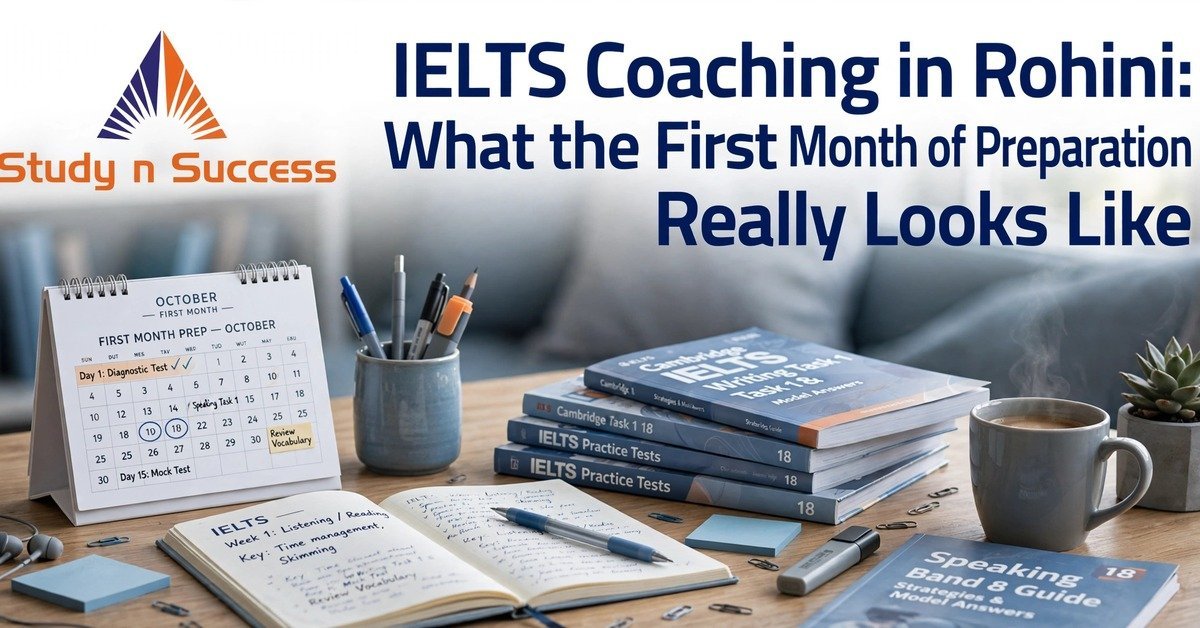
IELTS Coaching in Rohini: What the First Month of Preparation Really Looks Like
When students join IELTS coaching Rohini for the first time, most of them have the same picture in mind: a few weeks of classes, some practice tests, and then the exam. The reality is a little less tidy and a lot more useful. The first month of preparation is where your real level becomes clear, where your weak areas show up honestly, and where the habits that decide your result are formed. Knowing what that month actually looks like helps you use it properly instead of spending it wondering whether you are on track.
IELTS tests four skills: listening, reading, writing, and speaking. Most students arrive strong in one or two and shaky in the others, and they usually do not know which is which until they are tested properly. That is why the first weeks of any serious coaching are diagnostic as much as instructional. You are not just learning new things; you are finding out, in detail, what you already do well and what needs work.
Week One: Finding Your Real Level
The first week usually starts with an assessment: a full practice test or section-wise tests under exam-like conditions. Many students find this uncomfortable, because it exposes gaps they did not know they had. Someone who speaks English fluently at work may discover their academic writing is disorganised. Someone who reads novels easily may find the reading section’s time pressure brutal. This is normal, and it is genuinely good news, because a weakness you can see is a weakness you can fix.
Alongside the assessment, you learn the exam format properly: how many sections there are, how each one is timed, what the question types look like, and how the scoring works. This matters more than it sounds. A large number of students lose marks in their first attempts not because their English is poor, but because they did not understand what a question was asking or ran out of time in a section they could have handled. Knowing the format removes that entire category of avoidable loss.
By the end of the first week, a good coach can usually tell you, in plain terms, where you stand in each skill and what your preparation needs to focus on. That honest starting point is the foundation of everything that follows.
Weeks Two and Three: Building Skill by Skill
Once your level is clear, preparation becomes specific. Listening practice focuses on catching details in fast speech, following conversations with multiple speakers, and handling the different accents used in the recordings. Reading practice is less about reading more and more about reading strategically: finding answers under time pressure, recognising paraphrasing, and not getting stuck on one difficult question while the clock runs.
Writing gets the most attention in most batches, because it is where students typically struggle most. Academic writing for IELTS has a structure: task 1 asks you to describe data or a process, task 2 asks for an essay with a clear position and supporting points. Both reward organisation and clarity more than fancy vocabulary. In the first month, you learn to plan before writing, to organise paragraphs logically, and to avoid the common errors that drag scores down, like memorised phrases that do not fit the question.
Speaking practice starts early too, usually in pairs or with the trainer. The speaking test is a conversation, not a speech, and the skill it rewards is natural, organised talk: answering questions fully, giving reasons and examples, and keeping going even when you are unsure of a word. Students who practise speaking from the first month, rather than leaving it to the end, almost always sound more confident in the actual test.
The Role of Practice Tests and Feedback
Practice tests are the backbone of IELTS preparation, but only when they come with proper feedback. Simply doing test after test without understanding your mistakes is one of the least effective ways to prepare. A good coaching setup gives you mock tests and then goes through your errors with you: why a listening answer was wrong, where a reading answer was hiding, what made an essay weak, and how a speaking answer could have been better organised.
This feedback is where coaching earns its value over self-study. On your own, you can check answers, but you cannot easily see why your writing lacks coherence or why your speaking sounds hesitant. A trainer can, and can show you the specific fix. Over the first month, students who take feedback seriously usually see their practice scores move, sometimes in one skill first and then in others.
It is also worth understanding that scores fluctuate during preparation. One mock test may go well and the next badly, especially early on. That is normal and not a reason to panic or to change your entire approach. What matters is the trend over several tests, and whether your weak areas are shrinking.
Common First-Month Mistakes
The most common mistake is focusing only on your strongest skill because it feels good. Students who are comfortable speaking will happily do speaking practice all month while their writing stays weak. The exam scores all four skills, and your overall result is held back by your weakest one, so the first month should deliberately spend more time on what you find hardest, not what you enjoy most.
The second mistake is memorising model answers and fancy words. Examiners recognise memorised language immediately, and it hurts more than it helps. Natural, accurate English with a clear structure scores better than impressive vocabulary used incorrectly. Coaching should push you towards expressing your own ideas clearly, not towards collecting phrases to paste into answers.
The third mistake is irregular attendance and practice. IELTS preparation is a daily habit as much as a weekly class. Students who attend regularly, do the assigned practice, and revise their mistakes between classes progress visibly faster than those who attend in bursts. The first month sets this pattern: if you build the habit early, the rest of preparation becomes much easier.
What Progress Should Look Like After a Month
After a month of genuine preparation, you should be able to say concrete things about your own performance. You know which question types cost you marks. Your writing has a structure you can repeat. You can manage your time in reading and listening sections without panicking. Your speaking is more organised, even if it is not yet fluent. These are real, measurable improvements, even if your mock scores have not jumped dramatically yet.
You should also have a realistic sense of your timeline. Some students are ready to book the exam after a couple of months; others need longer, and that is fine. A good coach will tell you honestly where you stand rather than pushing you to book early. Rushing into the exam before you are ready is one of the most expensive mistakes in IELTS preparation, because it costs both the fee and your confidence.
Most importantly, after a month you should feel that the exam is understandable. The mystery is gone: you know the format, you know your weaknesses, and you have a plan for fixing them. That feeling, that the exam is a set of learnable skills rather than a lottery, is the real achievement of the first month.
How many hours a day should I study for IELTS?
Regular, focused practice matters more than long hours. Most students do well with their coaching classes plus an hour or two of daily practice: reading, listening exercises, writing tasks, and speaking practice. Consistency beats marathon sessions, and short daily practice keeps all four skills active.
Is coaching necessary, or can I prepare on my own?
Some students do prepare on their own, but coaching helps most in two areas: accurate feedback on writing and speaking, and a structured plan that covers all four skills. On your own, it is hard to judge your own writing or speaking objectively, and easy to neglect your weakest skill. Coaching fills exactly those gaps.
When should I book my IELTS exam?
Book it when your mock test performance is consistently close to your target across all four skills, not just one or two. Your coach can advise you based on your practice scores. Booking too early, before your weak areas are fixed, usually leads to a disappointing result and a retake.
Which section do most students find hardest?
Writing is the most common weak area, because academic writing has specific expectations around structure, task response, and coherence that everyday English does not teach you. Reading under time pressure is the second most common struggle. Both improve steadily with targeted practice and feedback.
Can I prepare for IELTS while working or studying?
Yes, and many students do. The key is a realistic daily routine: classes on fixed days, plus short daily practice that fits around your job or studies. A coaching centre in Rohini with batches that suit your schedule makes this much easier to sustain than irregular self-study.
The first month of IELTS preparation is less about dramatic breakthroughs and more about honest assessment, structured practice, and building habits that carry you to the exam. If you want that kind of preparation close to home, IELTS coaching Rohini at Study n Success offers skill-wise training, regular mock tests with feedback, and batches that fit working students. Visit us at Sector-3, Rohini, near Ayodhya Chowk, Delhi 110085, or call +91 99718 07449 or +91 99104 07449 to book a free demo class.