
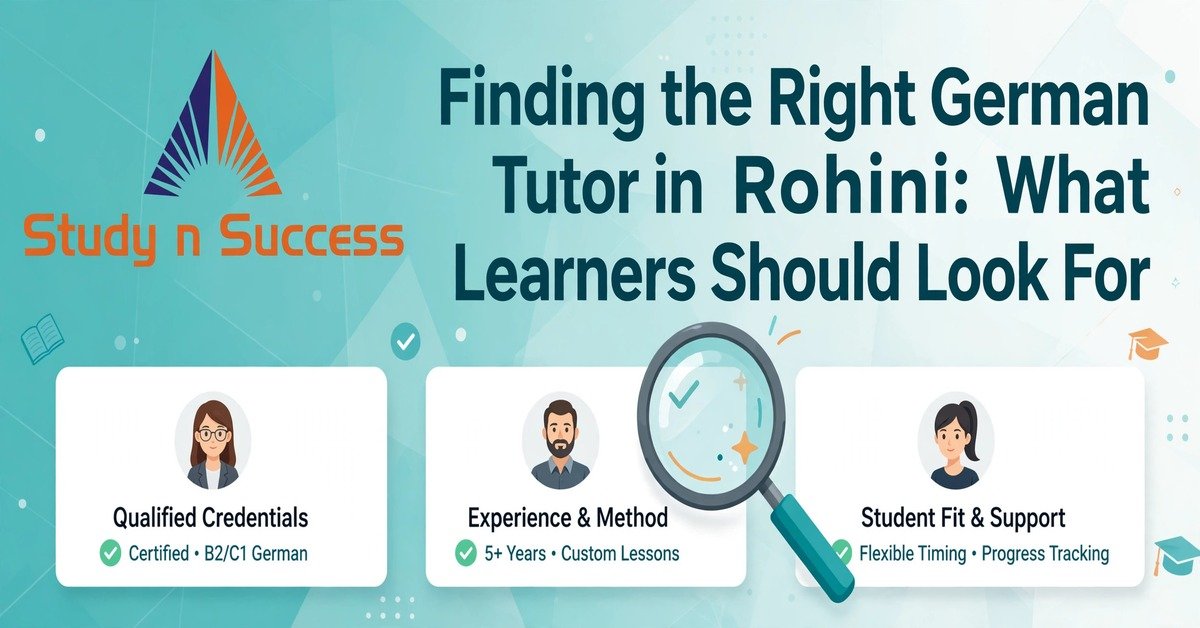
Finding the Right German Tutor in Rohini: What Learners Should Look For
When you decide to learn German Rohini learners usually face the same question first: should you study on your own, or find a tutor? Self-study sounds cheaper and more flexible, but most people who try it alone discover the same problem within a few weeks. Nobody is correcting their pronunciation, nobody is answering their questions, and nobody notices when they quietly stop practising. A good tutor changes all of that, and finding the right one in Rohini can make the difference between actually learning German and just collecting study material you never finish.
But not every tutor is right for every learner. Some tutors are brilliant at grammar but never get you speaking. Some are friendly but unstructured, so months pass without clear progress. And some simply do not suit your pace or your goal. This guide walks through what to look for in a German tutor Rohini, the questions worth asking before you enrol, and the warning signs that tell you to keep looking.
What a Good German Tutor Actually Does
A tutor’s real job is not to lecture you about German. It is to get you using German, and to correct you while you do it. In a good session, you spend most of the time speaking, listening, and doing exercises, while the tutor listens carefully, catches your mistakes, and explains them in a way you can actually apply next time. That feedback loop, speak, get corrected, speak again better, is the core of language learning, and it is the one thing self-study cannot give you.
A good tutor also plans your learning instead of just following a book page by page. They figure out where you are, what you struggle with, and what you need German for, and then they shape the lessons around that. A student learning German for work needs different practice from a student preparing for higher studies, and a tutor who recognises that will get you further in the same number of weeks than one who teaches everyone the same way.
Just as important is patience with the awkward phase. Every beginner sounds strange at first. German pronunciation, word order, and articles feel unnatural, and learners need a tutor who corrects without embarrassing them. If you are afraid of making mistakes in front of your tutor, you will stop speaking, and the whole point of having a tutor is lost.
Tutor vs Classroom: Which Suits You Better
One-to-one tutoring gives you undivided attention and a pace set entirely by you. Every minute of the session is yours, and the tutor can focus entirely on your weak areas. That suits learners with specific goals, unusual schedules, or a strong dislike of group settings. The trade-off is cost and the lack of classmates to practise with, which matters more than people expect: speaking with peers is less pressured and builds a different kind of confidence.
Classroom German language training, on the other hand, gives you classmates, regular schedules, and a lower cost per session. You hear other learners make mistakes and get corrected, which teaches you as well, and you get partners for pair work and conversation practice. For most learners, a small classroom batch offers the best balance: personal attention from the tutor plus the energy and practice partners of a group.
Many learners do best with a combination: regular classroom sessions for structure and speaking partners, with occasional one-to-one attention when they get stuck on something specific. When you visit an institute, ask whether that kind of flexibility exists. A place that only offers one rigid format may not suit you six months down the line, when your needs have changed.
Questions Worth Asking Before You Enrol
First, ask how much of the class is spent speaking. This is the single most revealing question you can ask. If the answer is vague, or if the class is mostly lectures and note-taking, you are not looking at speaking-focused training, whatever the name on the door says. German speaking classes should have students talking for a large part of every session.
Second, ask about the tutor’s approach to beginners. Do they speak German from the first class, or do they teach in Hindi or English for weeks before switching? A tutor who uses German from day one, with gestures, examples, and simple sentences, gets you comfortable with the sound of the language much faster. Some explanation in your own language is fine and often necessary, but the balance should shift towards German steadily.
Third, ask how progress is tracked. A good tutor can tell you what you will be able to do after a month, after three months, and so on, in concrete terms: introduce yourself, ask for directions, describe your routine, handle a simple conversation at work. Vague promises like “you will learn German” are not a plan. Concrete milestones are.
Fourth, ask about batch size and who else is in the batch. Learning with students at roughly your level matters, because a batch where half the students are far ahead leaves beginners silent, and a batch where everyone is a complete beginner can feel slow for someone who already knows the basics. A short assessment before placement is a good sign.
Warning Signs to Watch For
Be cautious of any tutor or institute that promises fluency in an unrealistically short time. Language learning takes steady work, and anyone guaranteeing fluency in a few weeks is selling, not teaching. Similarly, be wary of places that refuse a demo class. A confident tutor has nothing to lose by letting you sit in on a session, and a demo tells you more than any brochure.
Another warning sign is a tutor who never corrects you. It feels pleasant in the moment, but it means your mistakes are settling in uncorrected, and they become much harder to fix later. Good teaching feels supportive, not silently approving. You should leave most sessions having learned at least one thing you were doing wrong and how to do it right.
Finally, watch out for rigid, one-size-fits-all teaching. If every student gets the same material in the same order regardless of their goal or level, the teaching is not really personalised. Your reason for learning German should shape your lessons, at least to some extent.
Learning German in Rohini: Making It Practical
Location matters more than people admit. A tutor or institute in Rohini that you can reach easily, on a schedule that fits your week, is one you will actually attend consistently. German learning rewards regularity: two sessions a week, kept up for months, will beat an intense burst followed by a long gap. When you choose, be honest about your own routine. The best tutor in Delhi is useless to you if getting there twice a week is a struggle.
Also think about what support exists between sessions. Does the tutor give you speaking homework, not just written exercises? Can you ask doubts between classes? Is there any conversation practice outside the main session? These small things add up, because language learning happens in the hours between lessons as much as during them.
And remember that your own effort still matters. A tutor can correct you, guide you, and motivate you, but they cannot practise for you. The learners who improve fastest are the ones who speak out loud at home, revise between classes, and treat every session as practice time rather than a lecture to attend. A tutor accelerates your learning; they do not replace it.
How to Know Your Tutor Is Working
After a month with a good tutor, you should notice concrete changes. You understand simple spoken German better. You can say more without pausing to translate every word. You catch some of your own mistakes before the tutor points them out. These are real signs of progress, even if you still feel far from fluent.
If, after a month, you cannot say anything new, or if every session feels like the same material repeated, raise it with the tutor. Sometimes a small adjustment in method or pace fixes it. And if it does not, it is perfectly reasonable to look elsewhere. Staying with a tutor who is not working for you out of politeness is one of the most common ways learners waste months.
Is a private tutor better than a classroom batch?
It depends on your goal and budget. Private tutoring gives you full attention and a pace set by you, which suits specific goals or tight schedules. A small classroom batch gives you speaking partners, a regular schedule, and lower cost, which suits most learners. Many learners do well with classroom training plus occasional individual attention when they get stuck.
How do I know if a tutor is qualified?
Ask about their experience teaching German, not just their own knowledge of the language. Speaking a language and teaching it are different skills. A demo class is the best test: watch how they explain things, how much students speak, and whether corrections are clear and encouraging. That tells you more than any certificate on the wall.
Should the tutor speak only German in class?
Not from day one, but the balance should shift towards German over time. Early on, some explanation in a language you already know is normal and helpful. As you progress, a good tutor uses more and more German, because being surrounded by the language is how your ear and your confidence develop.
How often should I meet my tutor?
Regularity matters more than intensity. Two sessions a week, kept up consistently, works well for most learners. One session a week can work if you practise between sessions, but long gaps between meetings slow progress noticeably because you spend the first part of each session relearning what you forgot.
What if I feel shy speaking in front of a tutor?
Almost every beginner feels this way, and a good tutor expects it. Early sessions usually start with very simple exchanges, and the tutor’s job is to make mistakes feel normal rather than embarrassing. Most learners find the shyness fades within the first few sessions, especially when the tutor is patient and encouraging.
The right tutor makes German feel possible instead of intimidating, and the wrong one can put you off the language entirely, so choosing carefully is worth the effort. If you are looking for a German tutor Rohini who focuses on speaking, corrects you properly, and keeps batches small enough for real attention, visit Study n Success at Sector-3, Rohini, near Ayodhya Chowk, Delhi 110085, or call +91 99718 07449 or +91 99104 07449 to book a free demo and see a class for yourself.